The Bees’ Knees

It’s World Bee Day tomorrow and appropriately enough I can hear buzzing from the shed today. Honeybees keep trying to squeeze in between the wooden slats and get frustrated before reversing back out. Bumble bees drift clumsily by as if learning how to fly for the first time, now and then knocking against the window. There’s also the odd wasp, but since they don’t yet have their own UN-designated day, they note our attention on their insect cousins and are probably preparing to attack in jealous retaliation.

So it’s all about the bees. Here’s a few fun facts plus a delectable Brian Bilston poem (beautifully handwritten on this card last year by my friend, Roberta).

1. They are under threat 
Bees and other pollinators, such as butterflies, bats and hummingbirds, are increasingly under threat from human activities. But we need them because…

2.  Bees pollinate one in three mouthfuls we eat 
Almost 90% of the world’s wild-flowering plant species depend on animal pollination, along with more than 75% of the world’s food crops and 35% of global agricultural land. Not only do pollinators contribute directly to food security, but they are key to conserving biodiversity. No wonder lots of sci-fi stories involve the end of bees and then the end of the world as we know it.
 
3. Honeybees live in 50,000-strong colonies 
This number falls to around 10,000 in the winter when the remaining members huddle together and shake to keep warm - a hive therefore resonates all year round. They perfect this ‘waggle dance’ throughout the year to alert one another to the best places to find food. Their social nature (not to mention propensity to dance) could teach us a thing or two about life.
 
4. Male bees do not sting 
Honeybee workers (female, of course) have a sting in the tail - they protect the nest, sometimes to the death. But don’t let your patriarchy loose just yet, remember the queen bee? She’s in charge of tens of thousands. At least in one animal arena there’s a female CEO.

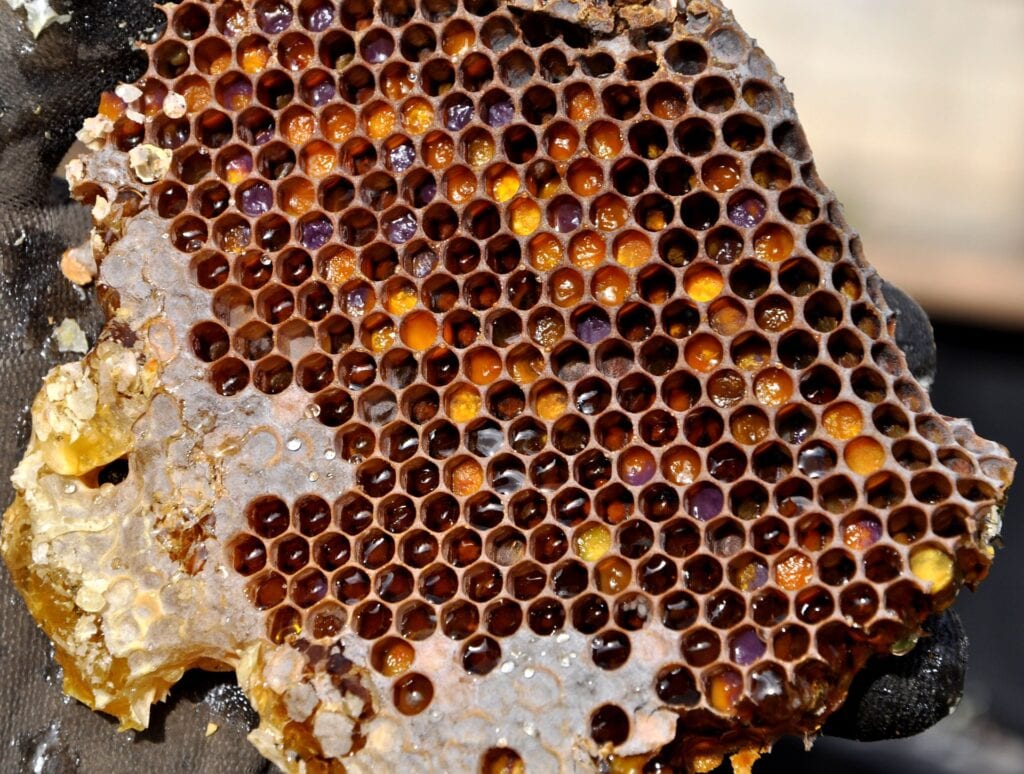
5. Hives (not to mention honey) are things of wonder 
The geometric columns of hive hexagons are like mini Giant’s Causeways (and also, it should be said, like Blockbusters - remember the stress of the gold run?)

The natural world just can’t be beaten for beauty and inspiration. We love you bees – please keep buzzing.

Friends Forever

Friendship bracelets. Nothing like them.

I re-connected with an old friend recently. Stephanie and I were inseparable at college, sharing essay deadlines, ‘early’ lectures (at 10am, I know) and the particular skill involved in making a student grant stretch each term. We ate a lot of sausages and noodles, and wore all our clothes at once rather than put the heat on. We even shared a tiny room in a truly terrible rented flat (the kitchen ankle-deep in water most days, the decor a mix of sixties floral and seventies beige). Happy days. And now twenty five years have passed and here we are sitting in the garden.

As an adult it’s hard to make friends, yet close friendships are consistently linked to better physical and mental health. Asking the question “will you be my friend?” is fraught with potential humiliation and rejection, so we wait and see, hoping that closeness will happen of its own accord. Maybe we need to be a bit braver and take steps to move from acquaintance to friend.

Female friendships are especially strong. There’s nothing like the close bond that forms when we share secrets, giggle at the same jokes and run to each other at the drop of a hat when life hurts. Katy allowed me to lean on her (literally at one point) during my brother’s funeral. Sally frequently delivers little thoughtful gifts. Cara makes me laugh with her potty-mouthed stories. Julie writes me letters. 

And as the blessings are many so, too, is the pain when a friendship ends. There’s really nothing like the loss of a deep connection. Love affairs end in heartbreak and we find sympathy in the telling; friendships end and we have nowhere to go with the grief. Self-criticism and a sharp loss fill our minds as we wonder what happened. And then technology allows for ‘ghosting’ until it slowly dawns that it’s over.

I still miss my best friend. We were opposites but the connection was instant. She moved back to England after fifteen years and following a silly argument about birthdays we simply lost touch. I sent messages and cards and then had to accept that she was no longer in my life. 

Friends are friends forever. It’s just that sometimes they shift and change as life moves on. I’ve reconnected with an old friend, found some new ones and so it goes.

Where would we be without them? Friends are silver and gold. Treasure them.

Sorry!

What do you do when someone walks into you? If you’re anything like me you apologise profusely, full of guilt that you had the temerity to get in someone’s way. Why am I like this? Don’t I deserve to take up space too?

Saying sorry is not unusual in these scenarios but sometimes the perpetrator hasn’t a clue and carries on with their day, blissfully oblivious. I was at a market festival in The Netherlands a while back and watched as a man knocked over a huge ceramic vase and then looked down at the broken pieces as if they’d been caused by someone else. He shrugged a little and walked off. Such nonchalance! I watched him go and shook my head in admiration. The stall holder shrugged too, and went off to find a broom.

We don’t really say sorry anymore, not properly at any rate. Maybe it’s the fear of litigation. ‘Don’t apologise, it admits guilt,’ say the insurance adverts. But surely admitting guilt is a good thing. It shows wisdom, an ability to see how your behaviour has affected someone else. 

All too often an apology is shallow and even points the finger elsewhere; my Dutch friend might have said that the vase shouldn’t have been left so close to the edge. Not his fault it got broken. 

But a heartfelt apology can lead to amazing things and as sympathy grows, so too does the potential for forgiveness and reconciliation. Imagine if he’d shown remorse and even helped to sweep up.

Sorry seems to be the hardest word. I hope I’ll soon be able to apologise when I have hurt someone and not just as a reflex when someone stands on my toes.

A Walking Shadow

Sitting down to write about Shakespeare is like a toddler confidently announcing his neurosurgery skills while wielding a knife. But it was his birthday this week so I feel the need to focus on the Bard. I’ll never win this fight but he is the worthiest of adversaries. 

I’ve always loved words and the effect they can have as we stumble through life. Bookworm childhood was my story and then, when the terrible teens struck, I found him. Just in time.

The 1989 RSC production of A Midsummer Night’s Dream in Belfast’s Grand Opera House quite honestly threw me to the ground and shook me awake. It was as if my eyes had opened for the first time to see all that life had to offer.  And obsession was the inevitable result. Any time we went to visit my aunt in England, I begged Dad to drive me to Stratford upon Avon whereupon I would traipse around the streets, visit the grave in Holy Trinity, watch the swans and buy teeny tiny copies of the plays so that they could always be in my pocket. I bought pencils and pencil sharpeners and bookmarks. I even got a sweatshirt with RSC emblazoned on the front and wore it every day. I painted a watercolour of Anne Hathaway’s cottage. I think I had some real friends in school too. 

Astonishing to think of this glover’s son first sharpening a quill. What possessed him? How did he create such worlds when he (doubtless) had never travelled far? Most of all – how did he know so much about life and love and loss? He wrote through the Black Death, he wrote for a Queen and then a King, he wrote as his 11-year-old son lay dying. He wrote words beyond compare. Could he have imagined his ink-stained hands reaching this far into the future? Over four hundred years, centuries of change and humanity rolling ever on, and still his words endure. 

I’ve stood in the room where he was born, sat in Anne Hathaway’s garden, read in the alcoves of Shakespeare and Company in Paris, gone behind the scenes at the Globe theatre in London, stood on Juliet’s balcony in Verona, even walked the Danish banqueting halls in Elsinore with Hamlet, and still I don’t feel like I know the writer. He is remote yet close, real yet intangible. No sooner have you grasped onto him than he flits away.

Therein lies his magic and it is the man himself. Bard, playwright, legend. William Shakespeare.

My reading of Sonnet 116

Silence is Golden

Pipe down out there. Life is loud, there’s no denying it: traffic, roadworks, dogs – it’s all happening. Silence is becoming so unusual that it’s almost mythical, the thing a lot of people long for but don’t know how to capture.

Noise pollution is a major concern, especially for city planners. Excessive noise can affect physical and mental health with heart disease, stress and sleeplessness on the increase. Even wildlife is affected with birds unable to hear a mate’s call.

I’m sitting by a lake in Austria. It was VERY QUIET.

You’ll probably not be surprised to hear that I love things to be quiet. I don’t mind those awkward silences in conversations either. We’re all wired differently, of course, but I’m one of those people who can’t really function without it. 

I went on a silent retreat to Corrymeela some years ago and felt as if I’d fallen into a pool of calm. No small talk chit-chat over the shared dinner breaks, no need to fill the gap, the pressure to talk taken away. It was glorious. 

And incredible things happened. For the first day or so I felt strange, hardly recognising myself. Who am I when I’m not talking? Uncomfortable truths started to emerge too, as if they’d been shouted down for years and had never been able to speak up. I looked at them, looked at the sea, and sat still. I was turbulent yet calm, settling into it and feeling my shoulders drop as my breath deepened. And I know that God sat next to me in this stillness.

This is the power of silence. It is full, meaningful, precious. It is both heavy and light. It’s no coincidence that as a society we hold a minute’s silence when the need arises to reflect and remember. Or the therapeutic intervention that sits in the room with someone who is in pain and says nothing – when words fail, silence speaks. 

Peace and quiet go hand in hand. Finding stillness in the rush of modern life is challenging but even a few minutes here and there can allow us to catch our breath. 

Silence is golden. Let it shine.