Little House on the Prairie

I spent the weekend in a glamping pod with best mates and their kids. Waking up to a big sky as trees wave through the window, avoiding rain showers by cuddling under blankets, barbecuing very (very) slowly, playing silly ‘would you rather’ games over fish and chips, sitting by the campfire with whiskey, staring at the stars. It was all rather blissful. Spending time with loved ones while out in the fresh air is surely one of life’s greatest pleasures.

And more than anything it was a reminder that I want to live more simply and take up less space in the world. Those clever little living pods were adorable and cosy. They had everything you could need. Most of all, they were small. Living in Hans the Van for a year and a half taught me so much about tiny living. We spent less during our travels than ‘normal’ life, we bought less (it wouldn’t fit in the cupboards) and we didn’t waste food because we bought fresh and local. I’d like to keep these lessons at the forefront of my mind these days. Now that I’m back to living in an actual house, I’ve noticed that I’m accumulating stuff yet again. It’s not a massive home but the cupboards and loft and shed are filling up. 

Modern life has pushed us towards debt: the big house, the big car, the big family holiday. Big, big, big. But what if we started to shrink things and see magic in the small? I’m keeping an eye out for a tiny cabin home (preferably in an equally tiny forest) and I’ll need to be able to fit all my worldly goods inside. So it’s time to clear out while remembering the mantra: the best things in life are free. 

Laughing with friends, stroking a cat, noticing new flowers starting to bloom, staring at the stars. Big things are small. Small things are big. Let’s start to get them the right way round.

Stand Still

Life is busy (December does this doesn’t it?) I’ve been spending a lot of time recently among trees. This poem ‘Lost’ by David Wagoner says it all. Press play, be still, breathe.

Poetry Reading

The Numbers Game

How do you feel about maths? If you’ve just broken out in a cold sweat, welcome to my world. Numbers have never been my friend and I’ve now accepted that they never will. It’s as if my brain is wired to treat them as a threat – should any wander innocently into my head it will attack them and turn them into mush. 

It’s often the way with creative types who see the world in words and colour so I know I’m not alone, but I’m still jealous of people who can do sums in their head (in their head! With no calculator!). Even if someone asks me to add up a very simple sum I freeze and panic. 

When I went to a university summer school a few years ago we all gathered in the lecture theatre and the professor of psychology welcomed everyone and outlined the plan for the first day. Turns out we were all going to introduce ourselves and then do some quick mental arithmetic and add it to the board at the front.

Well. Eyes widened. Hearts raced. And some (me) even began to reach for their coats. But she laughed soon enough and explained that some of her research also involves ‘maths anxiety’ (she gets to wire candidates up to monitor their physical reactions to doing equations). This summer school was not going to involve such things (thank heavens) so we gratefully moved on.

Numbers. I don’t like them. But this might be a good thing. Since stepping into the limelight last year I’ve purposely not looked (too hard) at viewing figures or levels of engagement. How many people are reading blog posts, engaging with the newsletter, liking Twitter posts? It’s exhausting to monitor such things – the numbers go up and down and my fragile ego likewise. Ignorance is sometimes bliss.

And more than that, it’s an acknowledgment that small is not necessarily worse than big in this game. Small numbers are cool. Just one person who laughed at a tweet or was moved by a story – that’s the sweet spot. Real connection is where it’s at. 

One plus one equals? Lots of happy readers and one happy writer.

An Irish Bluster

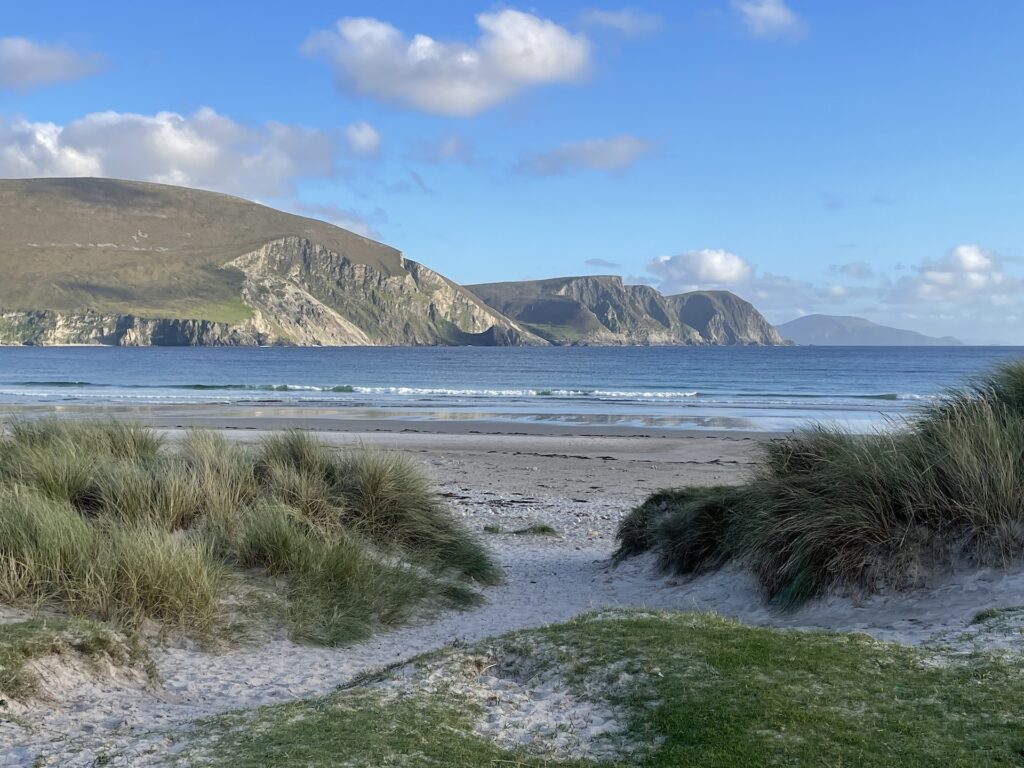
Achill Island sure aren’t you beautiful?

A week in the van in the west – it was blustery. There’s nothing quite like the bite of the Atlantic, falling asleep to the sound of the waves is the best lullaby in the world. On occasion it’s perturbing in the van if the wind picks up (I’ve been known to sit in the footwell, rocking back and forth with my eyes closed, picturing us toppling over at any moment). But being out in proper Irish weather certainly blew away all the cobwebs and opened my soul a little bit more to what nature can do for us. Sand between the toes, hood up, face misted with ocean spray and always, the wind. Wonderful.

It made me think of this poem by Ted Hughes. Best enjoyed in a cosy cabin as the wind howls down the chimney.

Best Laid Plans

For the past week I’ve been living out of a suitcase again and it’s completely brilliant. First my weekend writing retreat just outside Downpatrick and now bumping along the Wild Atlantic Way in the west of Ireland. 

I’d forgotten what travel felt like what with lockdowns, jobs and general Real Life happening. Our Big Trip in the van for a whole year around Europe and Scandinavia feels so long ago and yet here I am again, sitting on a deckchair beside Hans the Van, towels flapping in the (not insubstantial) breeze and feeling like this is real life. 

So the great retreat, I hear you ask, how was it? Did you get your sample chapter written? Well, it was great and, um, nope. I had aimed for 8-10,000 words and ended up with 6,000 or so. Not bad I suppose, but in the end, the main outcome of the writing retreat with my creative writing group was getting to know them better, and taking some big deep breaths in beautiful surroundings. 

Funny isn’t it? You can have a list of things to achieve with a colour-coded (I know) plan to tick as you go, but it turns out there’s been a secret list in front of your nose all along. Generally it involves surprises, unplanned detours, shared giggles, midnight sparklers under the stars and just being. It’s stopping all the hustle. And anyway, what’s a writer to write about if life happens and we don’t take notice? 

So I’m pleased with my progress. The Thomas Hardy chapter (a laugh riot, as you can imagine) is not quite done yet, but I know a little bit more about each member of my writing group, and I know a little bit more about what it means to stop and stare at a river for hours at a time. 

I’m sure my agent will understand the delay in sending the finished proposal…after all, the working title is ‘The Literary Pilgrim’ and here I am, being a pilgrim. That’s important research isn’t it?