Grounded

I made a difficult decision recently. It took ages, but as soon as I made it the air grew lighter and I could breathe again. Funny how we always say to trust our gut but end up ignoring it until it’s almost too late. Long (long) story short: I quit my job. 

Even writing that sentence gives me the jitters. Working class backgrounds tend to shout at us if we do something so rash. Plus, I feel guilty. Soon enough I’ll be able to move on from a job and an organisation I loved, and soon enough I’ll see that the transfer to a new company wasn’t going to work, no matter how hard I tried. Maybe I’ll see new pastures with new promise. But for now, I’m slowing down and releasing some of the pressure that comes from working in challenging criminal justice settings. Learning to breathe again is the thing.

And an odd quirk is helping. Wellness guides suggest various things at times of transition. I’ve tried getting up early (don’t like it), going for a run (sore knees), meditating (too quiet). But then I read about something called ‘grounding’. It’s the simplest thing: stand on the earth, preferably in bare feet, and ground yourself.

I scoffed, of course, and finished my coffee. But the image stuck in my head and I thought about it all day. I could picture my bare toes being tickled by fresh grass, while birds chirped happily in the trees above my head. My garden is small and a bit wild but it’s lovely. Maybe this was worth a try? So recently, with the arrival of spring, I’ve aimed to start each day (not too early, see above) by stepping out the back door and feeling the ground beneath my feet. The first day was a bust – sharp stones on my way to the grassy bit and generally too cold underfoot. This should have been expected. Rookie mistake. So next day I was better prepared: big slippers for the short journey from the door to the garden, and a warm cuppa in my hand. Much better! I slipped off the slippers and gingerly set my bare feet on the grass. It was cold and wet (dew? I hoped) but I took deep breaths and even a few steps. The birds were not singing. The cats were giving me funny looks. But I stuck it out. Soon enough, I ran back inside and found a pair of socks, apologising to my feet. Did this help? Did I feel grounded to Mother Earth?
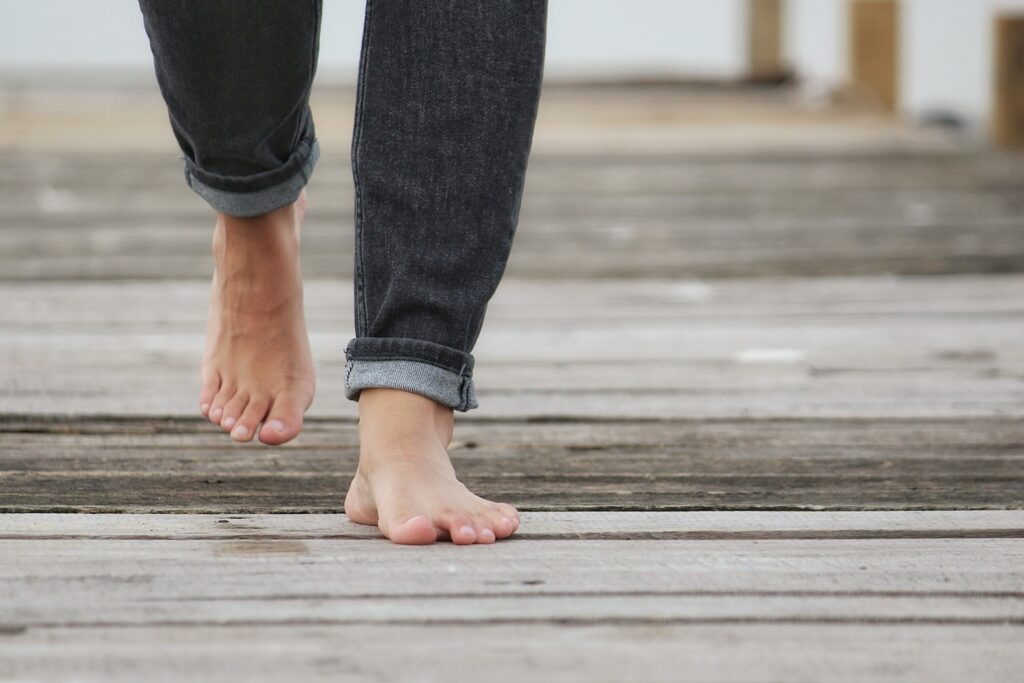
Well, yes. I’m getting better at leaning into it, I suppose. And like most habits, it’ll take time to grow. I feel like I’m allowed to be here, taking a stand as another day begins to unfold. Health worries and job anxiety melts away, and just for a few minutes, I’m simply a person who stands on grass. 

This simple act has continued to place me on the earth at this point in time. I don’t get out there every day, and sometimes the vibe is all wrong (and let’s not even mention the headless shrew incident). But most days I make it a priority to take barefoot steps outside. The birds sometimes sing and even the cats look on with a sense of, if not approval, certainly something approaching it. Deep changes are taking place as I stand and look into the sky. As a middle-aged woman, I have felt invisible and I’ve spent many years in the background. I didn’t think I was allowed to take up space. But the feeling of standing with skin touching earth, reaching back to my shoe-less ancestors, has taught me that I am here. And it’s enough.

Hold On Tight

Well, well, well, if it isn’t February already. People have always said that time speeds up as you get older, but I didn’t really believe them. It’s still a New Year, I reckon, and I’m trying to get used to it since January lasted about four months. It’s dark out there, in more ways than one: winter winds, unwelcome change and big bullies ruling the roost. I don’t like it.

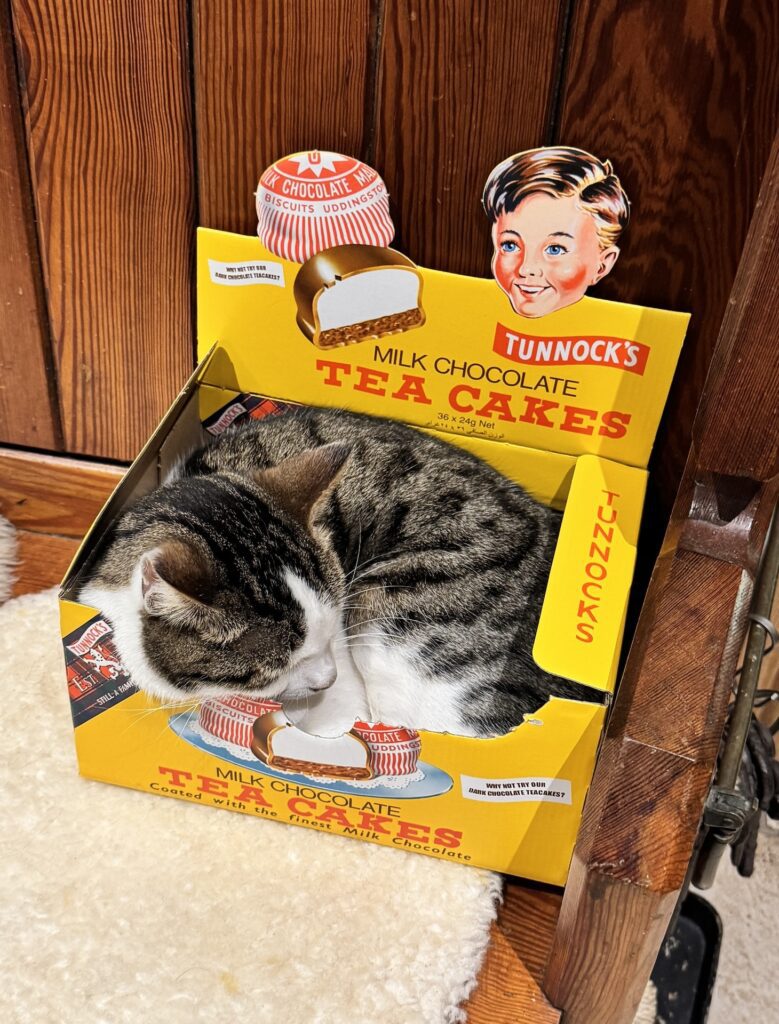
Penny the cat recently squeezed into a tiny cardboard box and slept all evening. I felt jealous. The thought of climbing into a cave, curling up and switching off the world was very attractive. But there was more to it than that. It was the thought of being enclosed and tightly wrapped, as if being held. A feeling of safety and security. I wanted that.

Even my clothing, I’ve noticed, is tight these days. Base layers of thermals and clingy polo necks are the thing. Skinny jeans have had their day, I know, and I don’t miss them (my knobbly knees are also relieved) but there’s something about the cosseting sensation that we surely all need these days. Therapist-speak calls it ‘emotional containment’. 

There will come a time to let it all hang out again, a time to feel free and safe as we move through the world. But for now, I’m wearing those vests and putting extra blankets on the bed and even asking for hugs when I need them.

Thankful Old Year

Small Things Like These

Over the last few weeks I’ve noticed that I’m drawn to innocent things: toys, cartoons, Pixar movies – even the little lamp at the start hops its way into my weary heart. 

The world is not in a good place right now and many of us are simply tired. Tired of hoping that goodness is paramount, that nations will step back from war. Tired of being disappointed when another bully wins or gets away with bad behaviour. Didn’t our mothers always tell us that life was the other way round? When did this rule change?

If my brain goes down these roads (and I try to tell it to stop) I end up picturing apocalyptic scenes with democracy lying dead in a ditch and books being burned and heavy boots stomping over people. Oh, and that’s if the earth is still even here. It’s too much right now. So I’m retreating from the news cycles (full of conditional tense and uncertainty anyway, I remind myself) and focusing instead on small things.

One of my favourite books, Small Things Like These by Claire Keegan, has been made into the most beautiful film. It’s quietly devastating. Harsh realities in a difficult world will always exist, humans can be cruel. And yet. 

And yet, we are fundamentally good. The story is also a reminder that smallness is no such thing. There are moments of transcendence all around us and kindness often arrives from the most unexpected place. 

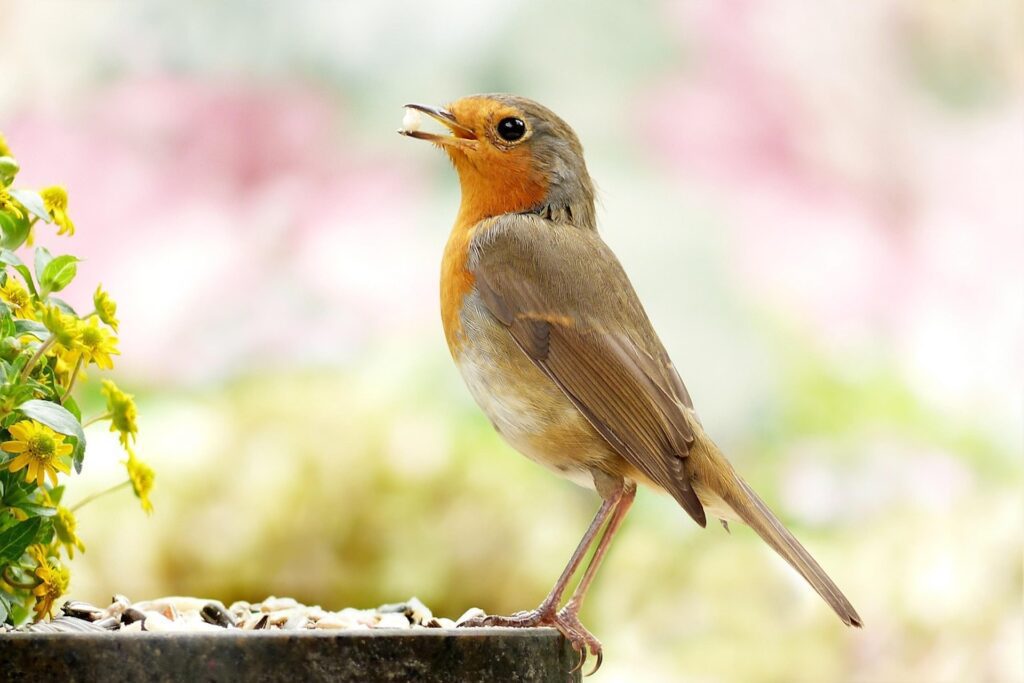
My small things include but are not limited to: the feel of the wind in my hair when I’m looking for the stars, crisp winter mornings when a robin sings from the shed roof, a cat purring contentedly on my knee when the day is done. 

It has meant a shift in the focus of my gaze but, little by little, the darkness is dissipating. We hold onto the things that matter, the things that will always prevail. 

Holding a Grudge

At the last count I hold about twenty seven grudges. Some of them are minor infractions of the ‘how dare they?’ variety, some of them are a lot bigger and some of them, let’s be honest, should no longer be on the list. But I’m happy to say that I’m in very good company.

’Tis the season for scary costumes but be careful if you’re wearing a creepy mask in the presence of a crow. These smart birds will not forgive you. A few years ago a zoologist in America learned that crows can recognise individual human faces, especially those they associate with bad experiences. (Same crow, same). But he also started to realise that the birds shared this new knowledge of dangerous humans with other crows.

John Marzluff and his research team at the University of Washington trapped, banded, and released eight American crows at different sites near Seattle. Before trapping the birds, the researchers donned different rubber masks (a caveman face, for example) and watched the reactions. While the birds were caged, nearby crows circled the site and sounded alarm calls, and when the masks were seen months later, the scolding continued.

Over a year later, John still couldn’t leave his office without being yelled at and pushed around by one particularly annoyed crow, even when he didn’t wear his mask. Families and fledglings and friends of the crow joined in, having decided they did not like this human. The grudge had begun.

Members of the Corvus family are funny and wise and smart. There’s something clever about holding a grudge – it keeps us on our toes, helps us to look out for bad behaviour and therefore stay safe. But it’s detrimental too.  Bitterness, like a poison, seeps. Psychologists suggest that rather than trying to focus only on forgiveness, we can find self-compassion, the very thing that was probably lacking at the time. If we can smooth the way to some kind of peace with what has happened, our minds and bodies will surely benefit. 

So far, so humanly interesting. But the crows in this Seattle experiment were right to scold – the researchers were dangerous. So keep hold of that grudge, clever crows, it’ll stand you in good stead for the future.